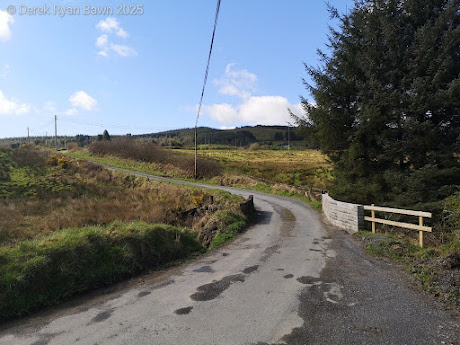
Ath Soluis or the Ford of Light near Kilcommon in Co. Tipperary.

By Derek Ryan 

"There is a bridge in Foilmahonmore called Ái Solas, or the "Ford of the Light". In olden times there was no bridge there & there used be a watch fire there to help travellers to cross the stream in safety at night time. It is a historic place, as it was that way Patrick Sarsfield came, when on his way to Ballyneety. Sarsfield & his men, led by the famous Galloping O'Hogan, left Limerick & from that on to the valley of Glean Cúlú & Foildubh and Kilcommon. When they reached At Solius, they turned the shoes on there horses so as to deceive their enemies. They they continued on their journey thro' Foilmahonmore, Croughmarka, Glengar and on by Carnahalla. On their way there was a stream on the side of the road where some of the officers stood to give drinks to their horses. One of the men said to the other, "I'll sell the "pass" or something to that effect. That minute the other officer, fearing he would spy on the others loaded his gun and shot him dead. After that they continued on their journey to capture the siege-train at Ballyneety." 

Faill Uí Chléirigh · The Schools' Collection | dúchas.ie

For more on Sarsfield's Ride - see the the Storymap I created of this amazing historic story. 

Sarsfields Ride

Comments

Popular posts from this blog

Hag Stones, are they an example of authentic Irish folklore or a neo-pagan import?

By Darkone CC BY-SA 2.0 The first time I ever heard of Hag-stones was this year. They are more commonly known as Adder stones and described on wikipedia as follows: " An adder stone is a type of stone, usually glassy, with a naturally occurring hole through it. Such stones have been discovered by archaeologists in both Britain and Egypt ."  In Britain they are also called hag stones , [1] witch stones , serpent's eggs , snake's eggs , or Glain Neidr in Wales , milpreve in Cornwall , adderstanes in the south of Scotland and Gloine nan Druidh ("Druids' glass" in Scottish Gaelic ) in the north. In Germany they are called Hühnergötter ("chicken gods"). In Egypt they are called aggry or aggri . Adder stones were believed to have magical powers such as protection against eye diseases or evil charms, preventing nightmares , curing whooping cough , the ability to see through fairy or witch disguises and traps if looked at ...

The Origins of the surname Ryan

NOTE: This is currently a work in progress and I ask for any feedback on what I have written. Ryan is one of the top ten surnames by population / number of people in Ireland. It would be nice if there was a simple explanation as to the meaning of the surname Ryan, unfortunately to my knowledge there isn't. The most likely explanation is that it goes back to a King or Chief of Idrone circa 900AD named Rian or Rien. It was around this time that the Irish began taking on surnames and it may be that it was after him his descendants began to be called, O or descendent of Rian. We are not sure how or when exactly the O'Mulryan name came about. It is likely that it means "descendent of the followers of Rian". However, this is not certain. We will see further down in this article that the genealogies suggest they are both descended from the same ancestor circa 900AD. Although other evidence does contradict this. Just what Rian means is not known for sure. Explana...

Ryan Family Nicknames

Over 500 individual Ryan Family nicknames - many with townlands associated with them. Click Here