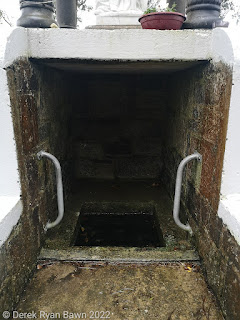
St Senans Well at Doonass

Some great folklore about St. Senan's Well in Doonass just on the Clare side of the River Shannon. Note the explanation for the nearby bullaun stone, where St. Senan fell off his horse and his head created an impression in the ground which is the bullaun stone. This stone is now reputed to help with headaches! There is also a link to Tipperary with the slates of the present roofed structure coming from Nenagh Courthouse. Also this St Senan was thought to have been a brother of St. Commaneth of Cragg Well in Tipperary.
"The Patron Saint of the district is Saint Senan. In the townland of Doonass about a mile from the village his Church is still to be seen. It is called Kiltannonlia or the Church of Saint Senan the Hoary.
Tradition says he belonged to a later period than St. Senan of Scattery Island. History is not very definite about the place of his birth. But the Patron Saint of the parish Birdhill near by is St. Cumman, his sister.
Near the Church is a holy well which people of the parish visit and give rounds on March 8th and August 15th. Many people were cured there, up to a few years ago the crutches of many cripples who were cured there were to be seen.
About a hundred years ago the well was desecrated by Sir Hugh Dillon Massey of Doonass, Protestant Landlord of the district hearing of the wonderful healing powers of the water he took a blind horse there to be cured, on bathing his eyes in the water the horse was instantly cured but strange to relate his owner was stricken with blindness. Another peculiarity about the water is that it cannot be boiled.
Tradition tells us that the Saint on returning from a mission to the Continent landed on the Wexford coast and travelling to the northwest founded holy wells on his way. On arriving in the present parish of Clonlara or Kiltannonlia as it was formerly called he founded there his church.
The story is told that while supervising the erection of the Church the Saint was mounted on a white steed. The steed happening to take fright endeavoured to throw his rider. The steed slipped on his knees and the prints are still visible in the solid rock. St. Senan's efforts to hold on failed he was thrown head forward on the quarry and the impact was so great that a circular hole about the twelve inches in diameter and sixteen inches in depth resulted. Shortly afterwards a spring appeared in the hole and the water issuing therefrom was noticed to possess peculiar healing-power that of healing people afflicted with warts. Subsequently the little well became known as St. Senan's Wartwell. Cures from other ailments such as headache, have been affected there too. The numerous offerings which are to be seen around the well bear testimony to the above statement."


Comments
Post a Comment